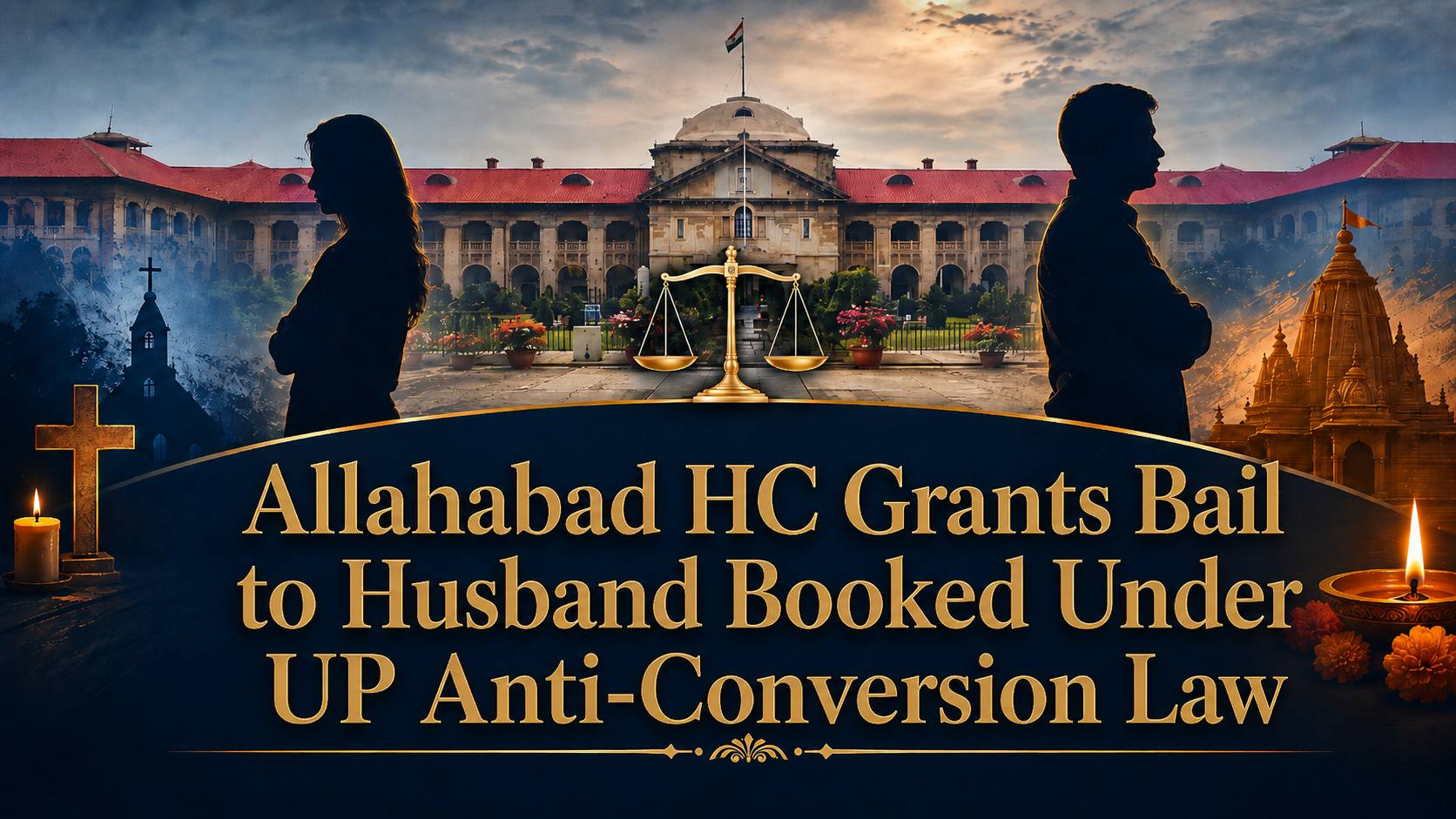
Defence argued that the complainant had herself acknowledged living with the applicant as husband and wife, while allegations of religious conversion surfaced only subsequently during the pendency of earlier bail proceedings
Allahabad, August 21, 2026: The Allahabad High Court has granted bail to a husband in a case involving allegations under Section 109(1) of the Bharatiya Nyaya Sanhita, 2023 and Sections 3 and 5 of the Uttar Pradesh Prohibition of Unlawful Conversion of Religion Act, 2021.
Justice Ashutosh Srivastava, while allowing Criminal Misc. Bail Application No. 27547 of 2026, observed that after considering the facts and circumstances of the case, the nature of accusations, severity of punishment, supporting evidence and the apprehension regarding possible tampering with witnesses, a case for grant of bail was made out. The Court expressly clarified that it was not commenting upon the merits of the case.
The applicant was directed to be released on furnishing a personal bond and two reliable sureties in the like amount to the satisfaction of the court concerned.
Case Originated From Matrimonial Dispute
The prosecution arose out of Case Crime No. 201 of 2026, registered at Police Station Bisrakh, District Gautam Budh Nagar.
According to the bail petition, the FIR was lodged on March 24, 2026 by the applicant’s wife. The petition records that the complainant herself stated in the FIR that she was residing with her husband at their residence in Gautam Budh Nagar. The original allegations primarily related to an incident alleged to have occurred between the couple at their residence.
The defence relied on this admitted matrimonial relationship while questioning the subsequent introduction of allegations under the Uttar Pradesh anti-conversion law.
It was specifically pleaded that the complainant had herself accepted that she had lived with the applicant in the relationship of husband and wife and that the later allegations concerning unlawful religious conversion required to be examined in the context of her original version.
Religious Conversion Allegations Surfaced Later
A central plank of the defence case was that allegations concerning religious conversion did not form part of the original case.
The bail petition states that during the pendency of the applicant’s earlier bail proceedings before the High Court, the complainant gave a further statement under Section 180 of the Bharatiya Nagarik Suraksha Sanhita on May 15, 2026, containing fresh allegations relating to religious conversion. It was thereafter that Sections 3 and 5 of the Uttar Pradesh Prohibition of Unlawful Conversion of Religion Act were added.
The index to the petition itself describes the May 15 statement as containing fresh allegations of religious conversions, following which the provisions of the anti-conversion law were added.
The High Court’s order also records this sequence. It notes that during the pendency of the earlier bail application, the complainant’s statement under Section 180 BNSS was recorded on May 15, 2026 with additional allegations and that a supplementary charge sheet was thereafter filed adding Section 109(1) BNS and Sections 3/5 of the Uttar Pradesh Prohibition of Unlawful Conversion of Religion Act.
Earlier Bail Had Already Been Granted
The defence also pointed out that the applicant had already been granted bail by the Allahabad High Court in the same case crime number in relation to the offences originally invoked against him.
The earlier bail application, Criminal Misc. Bail Application No. 15684 of 2026, was allowed on May 18, 2026. The present petition states that the Court had then considered the nature of the offence, the material and evidence on record, the alleged complicity of the accused and the severity of punishment before granting bail.
The present bail application became necessary after additional provisions were introduced through a supplementary charge sheet.
According to the petition, a supplementary charge sheet dated May 24, 2026 added Sections 3 and 5 of the Uttar Pradesh Prohibition of Unlawful Conversion of Religion Act along with Section 109(1) BNS.
The defence therefore argued that the applicant, despite having already obtained bail in relation to the allegations forming the foundation of the original FIR, continued to remain in custody because of the subsequently added provisions.
Later Charges Were an ‘Afterthought’, Defence Contended
The bail petition strongly challenged the timing and manner in which the additional offences were brought into the case.
The applicant’s case was that the subsequent addition of Section 109(1) BNS and Sections 3 and 5 of the Uttar Pradesh anti-conversion law was mala fide, motivated and an afterthought.
It was argued that these allegations surfaced only after the earlier bail proceedings had commenced and were based on a fresh and improved version subsequently given by the complainant. The defence contended that the additional allegations had been introduced with the object of frustrating the benefit of bail already granted to the applicant.
The petition further asserted that nothing had been recovered from the applicant and that he had already secured bail in relation to the principal offences arising from the original FIR. It also described the later addition of offences after the earlier grant of bail as an abuse of the process of law.
These were submissions advanced on behalf of the applicant. The High Court, while granting bail, did not return any final finding on the truth or otherwise of the allegations and specifically refrained from commenting on the merits of the case.
“Timing of Anti-Conversion Charges Was Crucial”: Adv. Aashish George
Adv. Aashish George, who drafted the bail petition, told The Law Daily that a key aspect of the defence was the timing of the addition of the provisions under the Uttar Pradesh Prohibition of Unlawful Conversion of Religion Act.
He said that the original FIR did not contain allegations of religious conversion and that such allegations surfaced only later, during the pendency of the earlier bail proceedings. According to him, the defence therefore urged the Court to examine the subsequent addition of Sections 3 and 5 of the Act in the context of the complainant’s earlier version and the fact that the applicant had already been granted bail in respect of the original offences.
Adv. George further stated that the defence case was that the later introduction of the anti-conversion provisions amounted to a material improvement in the prosecution version, and that the chronology of events was central to the prayer for bail.
He added that the complainant’s own earlier description of the parties as living together in a husband-wife relationship was also relied upon while questioning why allegations under the anti-conversion law surfaced only at a subsequent stage.
No Criminal Antecedents, Defence Told Court
Counsel for the applicant further submitted before the High Court that the applicant had no criminal antecedents and that there was no likelihood of him fleeing from the course of justice or tampering with evidence if released on bail.
The State, represented by the learned Additional Government Advocate, opposed the bail application.
After hearing the parties and examining the record, the High Court concluded that a case for bail had been made out.
Counsel Appearance
The matter was represented for the applicant by Senior Advocate Pradeep Chandra, assisted by Adv. Pratik Chandra, Adv. Aashish George, Adv. Urvya Preman, Adv. Durgesh Kumar Shuklaa and Adv. Anurag Ranjan Srivastava.