
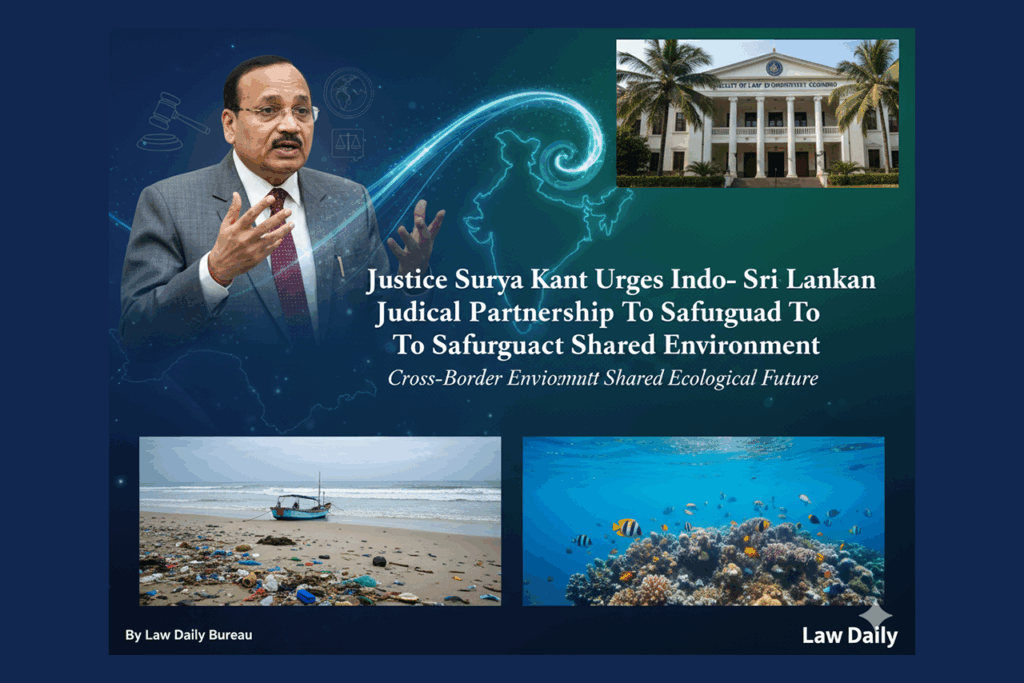
Delivering a stirring call for cross-border environmental collaboration, Justice Surya Kant of the Supreme Court of India has urged the Indian and Sri Lankan judiciaries to take the lead in shaping a regional model of environmental constitutionalism — one that recognises that certain ecological rights and duties go beyond national borders.
Speaking at the Indo–Sri Lanka Policy Dialogue on Advancing Environmental Sustainability and Regional Cooperation, hosted by the Faculty of Law, University of Colombo, Justice Kant said that the time had come to transform “desirable cooperation” into urgent, coordinated judicial action to confront pressing transboundary ecological challenges.
“The time is ripe for the Indian and Sri Lankan judiciaries to champion a model of regional environmental constitutionalism—recognising that certain imminent environmental rights and duties transcend borders,” Justice Kant emphasised.
Shared Ecological Futures
Justice Kant reflected on the deep ecological interdependence of India and Sri Lanka, describing how the Indian Ocean has long served as a bridge of continuity, linking both nations through history, culture, and shared natural systems.
He observed that “beneath the calm turquoise waters of the Palk Strait lie stories of ecological fragility—oil spills drifting from one shore to another, coral reefs bleaching under warming currents, and fishing communities struggling for survival.”
The Palk Bay and the Gulf of Mannar, once biodiversity-rich regions, are now facing severe ecological strain due to overfishing, illegal trawling, and unregulated coastal activity. Justice Kant described the frequent confrontations between Indian trawlers and Sri Lankan fishers as “a symptom of a deeper environmental tragedy—competition for an exhausted resource base.”
He also drew attention to the shared threats of climate change, including saltwater intrusion, marine pollution, and microplastic accumulation, calling for joint monitoring, coordinated disaster response, and scientific data sharing to safeguard the fragile marine ecosystem.
Judiciaries as Guardians of Ecological Justice
Justice Kant stressed the judiciary’s constitutional responsibility to uphold environmental balance, describing it as both a moral and legal guardian of nature’s rights.
He praised the evolution of India’s environmental jurisprudence, where the Supreme Court—through an expansive reading of Article 21 (Right to Life)— has recognised the right to a clean and healthy environment as a fundamental human right. Doctrines such as sustainable development, polluter pays, and the precautionary principle have since become cornerstones of Indian environmental law.
Similarly, he acknowledged the Sri Lankan Supreme Court’s progressive stance under Article 27(14) of its Constitution and in landmark cases like the Eppawela Phosphate Case, which upheld the public trust doctrine and intergenerational equity, reinforcing the duty to preserve natural resources for future generations.
“In the absence of robust regional institutions, courts have become de facto arenas for transnational accountability,” Justice Kant said. “Judicial pronouncements influence executive behaviour, compel environmental reporting, and often drive policy reform.”
Building a Regional Judicial Framework
To strengthen regional ecological governance, Justice Kant proposed the formation of a Joint Commission on Marine Ecology empowered to issue advisories and recommendations on transboundary environmental concerns.
He also suggested establishing data-sharing protocols between India and Sri Lanka for real-time monitoring of marine pollution, fisheries management, and coastal sustainability, along with joint judicial workshops under the BIMSTEC framework to develop shared interpretive standards for environmental rights.
Justice Kant further revealed that Sri Lanka’s Chief Justice, Justice P. Padman Surasena, along with other members of the Sri Lankan Supreme Court, is expected to visit India later this year or early next year to deepen the ongoing judicial dialogue. He described this exchange as a “significant step” toward institutionalising regional environmental cooperation.
“The Bay of Bengal Does Not Divide Us; It Binds Us”
In his concluding remarks, Justice Kant delivered a moving reminder of the shared destiny that binds India and Sri Lanka through their ecosystems rather than their borders.
“The Bay of Bengal does not divide us; it binds us through a shared ecological fate,” he said. “Let us reimagine the Indo–Sri Lankan partnership not merely as a bilateral relationship but as a collective guardianship of the Indian Ocean commons—where cooperation is measured not in treaties signed, but in ecosystems restored and communities made resilient.”
Justice Kant asserted that environmental cooperation between the two nations is not a matter of diplomacy or charity—it is a matter of survival. His remarks resonated deeply with the audience, which included members of the Sri Lankan judiciary, law faculty, students, and senior officials from environmental and legal institutions.
Towards a Shared Vision of Regional Environmental Constitutionalism
Justice Kant’s address marks an important moment in the evolution of regional environmental jurisprudence. His call for Indo–Sri Lankan judicial collaboration reflects a growing recognition that climate change, biodiversity loss, and marine degradation require cross-border legal responses.
By urging both nations to adopt a shared constitutional vision for environmental protection, Justice Kant highlighted how judicial cooperation can bridge the gap between national law and regional ecological reality. If realised, his proposal could pave the way for a South Asian model of environmental constitutionalism—rooted in shared responsibility, intergenerational justice, and a commitment to preserve the Indian Ocean ecosystem for future generations.

