
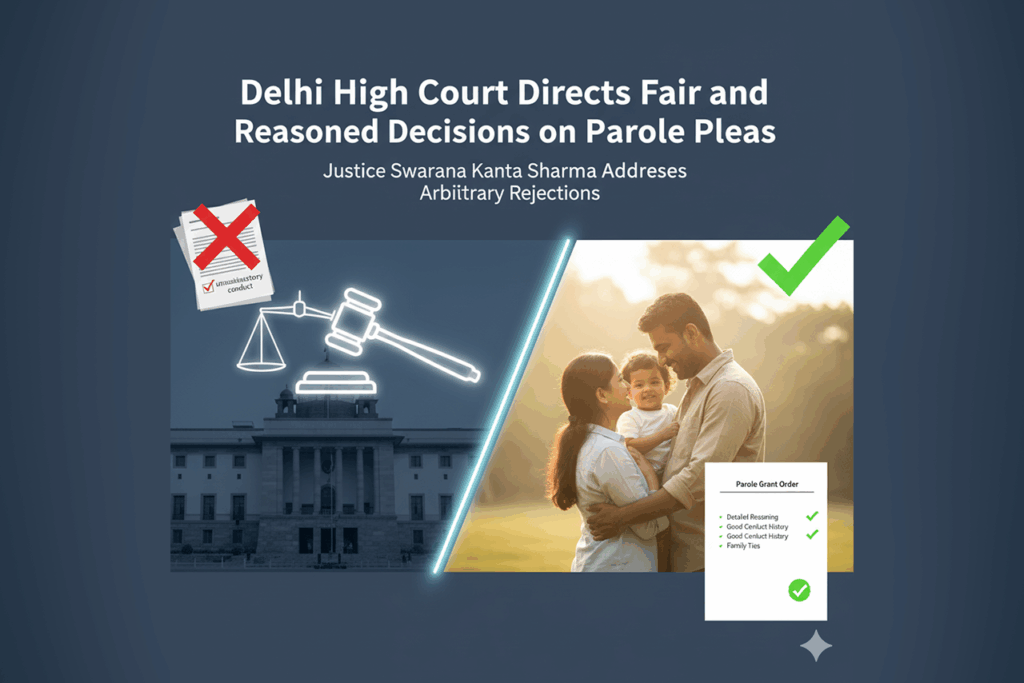
The Delhi High Court has issued comprehensive directions to ensure that applications for parole and furlough by convicts are decided in a fair, transparent, and reasoned manner, addressing a “recurring” pattern of rejection without proper justification.
The directions were issued by Justice Swarana Kanta Sharma while hearing a plea filed by a murder convict seeking parole to re-establish social ties with his family and reintegrate into society. The convict had been sentenced to rigorous imprisonment for life under the Arms Act, a sentence later confirmed by the Supreme Court in 2017.
Background of the Case
The petitioner sought parole for one month, but his application was rejected by the competent authority on the sole ground that his overall jail conduct was unsatisfactory.
Upon examining the Nominal Roll — the official record of prison conduct — the Court found that the convict’s conduct over the past year had been specifically recorded as satisfactory. Moreover, the convict had previously availed several furloughs and parole opportunities without misusing the liberty granted.
Justice Sharma observed that the competent authority had mechanically relied on two minor punishments awarded in 2018–2019, without considering the convict’s good conduct spanning six years. Such an approach, the Court noted, undermines the principles of objectivity, fairness, and the reformative purpose of imprisonment.
Key Directions for Authorities
To prevent arbitrary or mechanical decisions, the Delhi High Court laid down a detailed procedure for handling parole and furlough applications:
1. Detailed Reasoning: Authorities must specifically record reasons for rejection, citing instances of misconduct along with relevant dates from the Nominal Roll.
2. Nature of Punishments: Authorities should consider whether punishments, if any, were major or minor, and whether they were approved by the District & Sessions Judge in accordance with the Delhi Prison Rules.
3. Full Jail Conduct History: The entire history of the convict’s jail conduct, including previous furloughs, parole, emergency parole, or interim bail, must be considered.
4. Compliance with Conditions: Reference must be made to whether the convict surrendered on time and complied with conditions of previous releases.
Justice Sharma emphasized that these directions must be followed in letter and spirit to ensure that decisions on parole and furlough are transparent, reasoned, and justifiable.
Implementation and Oversight
The Court ordered that a copy of the judgment be sent to all Jail Superintendents in Delhi, as well as to the Secretary, Department of Home, Government of NCT of Delhi, to ensure uniform compliance across the capital’s prisons.
This ruling reinforces that temporary release decisions must not be guided by outdated records or arbitrary assessments. Rather, authorities are expected to balance disciplinary concerns with the reformative goals of imprisonment, ensuring convicts have a genuine opportunity to rehabilitate.
Context: Why the Ruling Matters
Parole and furlough are temporary relief mechanisms within the prison system, allowing convicts to re-establish social bonds and reintegrate into society. While prison discipline is essential, the overall conduct and rehabilitative progress of convicts must guide decisions on temporary release.
Legal experts note that the Delhi High Court’s judgment is aligned with the broader principles of reformative justice, emphasizing:
∙ Fairness and Objectivity: Rejections must be reasoned and documented.
∙ Rehabilitation Over Retribution: Convicts showing good conduct should not be denied release mechanically.
∙ Transparency: Clear records of misconduct and compliance must accompany every decision.
“The competent authority must avoid mechanical reliance on minor punishments and instead evaluate the convict’s overall behavior, reformative progress, and adherence to previous parole conditions,” Justice Sharma said.
Impact on Prison Administration
The judgment in Kanta Prasad v. State of NCT of Delhi serves as a guiding precedent for prison authorities and courts across India. It sets the expectation that parole and furlough applications must be considered holistically, not just based on isolated incidents or minor disciplinary records.
By mandating reasoned and documented decisions, the Court has reinforced the principles of accountability, fairness, and rehabilitative justice. It underscores that temporary releases are not mere privileges, but instruments to promote social reintegration and reform.
Conclusion
This ruling addresses a longstanding challenge in prison administration — arbitrary rejection of parole and furlough pleas. By directing authorities to examine the entirety of a convict’s conduct, past compliance, and reformative behavior, the Delhi High Court has strengthened the rule of law within correctional procedures.
The judgment demonstrates the judiciary’s commitment to ensuring justice is not only punitive but reformative, balancing the rights of convicts with public safety and prison discipline. Law Daily will continue to track the implementation of these directives and their impact on parole and furlough processes across Delhi’s prisons.

