
In a significant order that blends justice with reform, the Delhi High Court has quashed a 2019 FIR lodged under charges of sexual harassment and criminal intimidation, after the complainant and accused — who are related — reached a mutual family-based settlement. While closing the case, the Court chose not to let the matter end without consequence. It directed the accused to undertake community service and make a monetary contribution to the welfare of the police force, symbolizing a restorative, rather than merely punitive, approach to justice.
The Case and Background
The case was registered as FIR No. 202/2019 at Police Station Bhajanpura, Delhi, under Sections 354, 354A, 354B, 506, and 509 of the Indian Penal Code (IPC) — offences relating to outraging the modesty of a woman, sexual harassment, and criminal intimidation.
The complainant, who was a family member of the accused, approached the High Court stating that she no longer wished to pursue the criminal proceedings. She informed the Court that the dispute was family-related and had arisen out of personal discord and misunderstandings. Over time, as family elders passed away and relations between the parties stabilized, the complainant expressed her desire to move on and restore harmony.
During the hearing, both sides submitted that they had resolved their differences and that continuing the prosecution would serve no useful purpose. The State also did not oppose the quashing, considering the nature of the dispute and the settlement reached.
Court’s Observations and Reasoning
Justice Anish Dayal, presiding over the matter, carefully examined the facts and the nature of allegations. The Court noted that since the complainant had voluntarily agreed to withdraw the complaint and no coercion or pressure was alleged, there was no justification to prolong the criminal proceedings.
The Court further observed that the possibility of conviction in such circumstances was “remote and bleak.” Once the complainant had lost interest in supporting the prosecution, the criminal trial would merely become an empty formality, consuming precious judicial time and state resources.
Justice Dayal emphasized that while crimes of sexual nature are serious, not every case warrants continued prosecution when the underlying dispute is essentially domestic or personal in character, and both parties genuinely wish to reconcile. The Court remarked that the justice system must distinguish between heinous offences demanding deterrence and interpersonal disputes that have lost adversarial intensity.
Accordingly, the High Court quashed the FIR and all proceedings arising from it, bringing closure to a long-pending matter.
Conditions Imposed — Service with Accountability
While granting relief, the Court was mindful of maintaining a sense of responsibility on the part of the accused. Justice Dayal made it clear that quashing an FIR on the ground of settlement should not amount to an unconditional exoneration.
The Court, therefore, imposed certain conditions of community service and contribution:
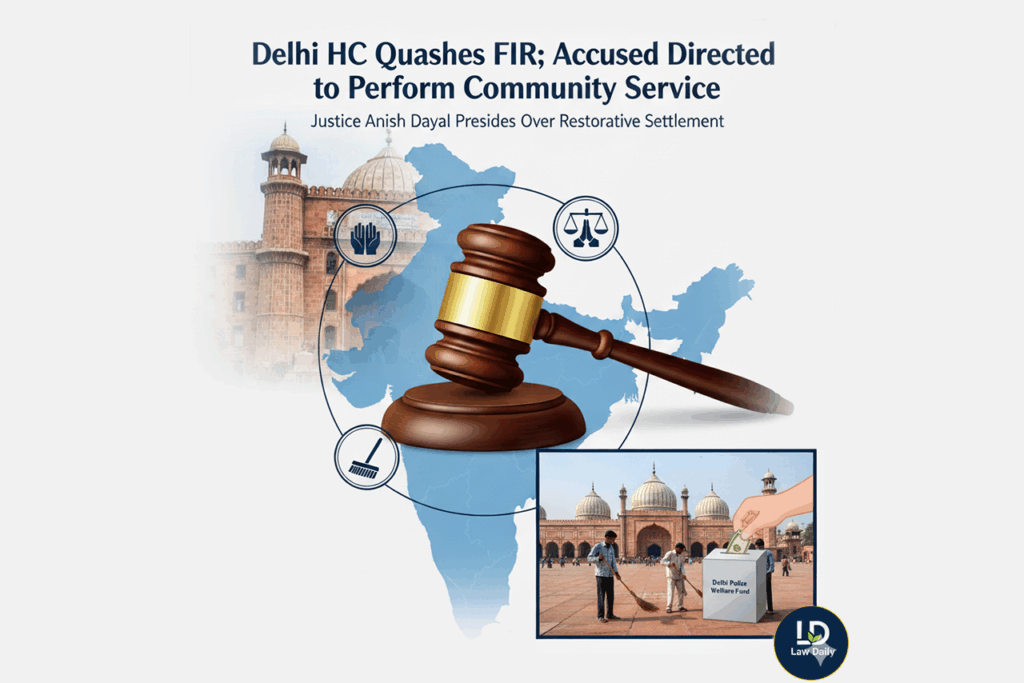
∙ Each petitioner was directed to deposit ₹5,000 into the Delhi Police Welfare Fund within two weeks.
∙ They were also ordered to perform community service at Jama Masjid, four days each month for two consecutive months, dedicating four hours per day.
∙ Additionally, the accused had to give an undertaking before the Court that they would not repeat such behavior or engage in similar conduct in the future.
The directions reflect the Court’s view that reconciliation must be accompanied by reflection and reform, ensuring that the process of forgiveness carries a constructive outcome for society.
Legal Context and Broader Significance
This decision aligns with a series of judicial pronouncements where courts have adopted a restorative approach in quashing criminal proceedings, especially those arising from family, matrimonial, or social disputes. The Supreme Court, in precedents such as Gian Singh v. State of Punjab (2012) and Narinder Singh v. State of Punjab (2014), has recognized that courts possess the inherent power under Section 482 CrPC to quash criminal cases if continuing them would serve no purpose and if parties have genuinely reconciled.
However, the Delhi High Court’s approach in this case goes a step further. Instead of a simple quashing, it introduced elements of social accountability — by requiring community service and financial contribution. This reinforces the idea that justice can be restorative, not merely retributive.
Legal observers note that this trend reflects a maturing understanding of justice — one that values rehabilitation and responsibility over mechanical punishment. By ensuring that the accused contributes positively to society, the Court converts a private resolution into a publicly beneficial act.
Why the Order Matters
The order represents a balanced judicial philosophy, recognizing both the need to reduce the burden on the criminal justice system and the importance of preserving the dignity of all parties involved.
By allowing the complainant’s wish to withdraw the case, the Court respected her agency and choice. At the same time, by mandating community service, it reinforced that even settled cases should promote social learning and accountability.
In a broader sense, the judgment showcases how the judiciary can use creative sentencing and conditional relief to serve multiple goals — reconciliation, deterrence, and public good. It sends a message that forgiveness in law does not equate to freedom from responsibility.
Looking Ahead
The case adds to a growing body of jurisprudence that encourages human centered justice — one that adapts to the circumstances and emotional realities of those before the court.
By making the accused perform community service and contribute to welfare initiatives, the Delhi High Court has set a precedent for integrating social responsibility into judicial outcomes.
As this case demonstrates, the true measure of justice lies not only in punishing wrongs but also in restoring balance and promoting reform. Law Daily will continue to monitor similar developments where courts use their discretion to promote restorative justice and community-oriented accountability.

